
JOINTS ,MASCULOSKELETAL SYSTEM
There are 3 types of joints
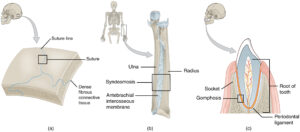
1- Fibrous joint
EXAMPLE- 1-Sutures of the skull
2-Syndesmosis (Between tibia and fibula)
3-Gomphosis (Tooth in socket)
2- cartilaginous joint
EXAMPLES
1-Intervertebral joints
2-Pubic symphysis
3-Joints between ribs and sternum
3- Synovial joint
Examples
1-Shoulder joint
2-Knee joint
3-Hip joint
Fibrous joint
A fibrous joint is a joint where two bones are joined together by fibrous connective tissue.
There is no joint cavity, so movement is absent or very little.
Examples of fibrous joints:
Sutures of the skull –
Syndesmosis – joint between tibia and fibula
Gomphosis – joint between tooth and jaw socket
Cartilaginous joint
A cartilaginous joint is a joint where two bones are joined together by cartilage.
Movement is slight.
Examples of cartilaginous joints:
Intervertebral discs (between vertebrae)
Pubic symphysis
First rib with sternum
Synovial joint
A synovial joint is a joint where two bones are separated by a joint cavity filled with synovial fluid.
It allows free movement.
Examples of synovial joints:
Knee joint
Shoulder joint
Hip joint
Elbow joint
Characteristics of a synovial joint (simple)
1-Articular cartilage
– Smooth cartilage covering the ends of bones
– Reduces friction and absorbs shock
Joint capsule (Capsule)
– Strong covering around the joint
– Holds the bones together
2-Synovial membrane
– Inner lining of the capsule
– Produces synovial fluid
3-Synovial fluid
– Thick, slippery fluid inside the joint
– Lubricates the joint and nourishes cartilage
4-Intracapsular structures-
Structures inside the capsule but outside the synovial membrane
– Help in stability
– Example: menisci and fat pads (knee joint)
5- Extracapsular structures– Structures outside the joint capsule
– Provide extra support
– Example: ligaments and muscles
Nerve and blood supply of a synovial joint
Nerve supply
Nerves that move the joint also supply the joint
They supply the capsule and ligaments
Help in feeling pain and movement
Blood supply
Blood comes from nearby arteries
Blood vessels supply the capsule and synovial membrane
Articular cartilage has no blood supply (it gets nutrition from synovial fluid)
Types of synovial joints (simple with examples):
Ball and socket joint
– Ball-shaped head fits into a cup-shaped socket
– Movement in all directions
– Example: Shoulder joint, Hip joint
Hinge joint
– Movement like opening and closing a door
– Allows bending and straightening
– Example: Elbow joint, Knee joint
Gliding (plane) joint
– Flat surfaces glide over each other
– Limited movement
– Example: Wrist joints, Ankle joints
Pivot joint
– One bone rotates around another
– Rotation movement
– Example: Joint between atlas and axis (neck)
Condyloid (ellipsoid) joint
– Oval-shaped surface fits into another
– Movement in two directions
– Example: Wrist joint, Metacarpophalangeal joint
Saddle joint
– Saddle-shaped surfaces fit together
– Movement in two directions
– Example: Thumb joint
Movement of synovial joints
1-Flexion
– Bending a joint
– Decreases the angle between two bones
– Example: Bending the elbow or knee
2-Extension
– Straightening a joint
– Increases the angle between two bones
– Example: Straightening the elbow or knee
3-Abduction
– Movement away from the midline of the body
– Example: Lifting the arm sideways
4-Adduction
– Movement towards the midline of the body
– Example: Bringing the arm back to the side
5-Circumduction
– Circular movement combining flexion, extension, abduction, and adduction
– Example: Moving the arm in a circle
Rotation
– Turning a bone around its own axis
– Example: Turning the head side to side
Pronation
– Turning the palm downward
– Example: Placing the palm facing the floor
Supination
– Turning the palm upward
– Example: Holding a bowl of soup
Inversion
– Turning the sole of the foot inward
– Example: Twisting the foot towards the midline
Eversion (correct term instead of “version”)
– Turning the sole of the foot outward
– Example: Twisting the foot away from the midline
Fibrous Joints
1- Fibrous joints are joined by:
A. Cartilage
B. Synovial fluid
C. Fibrous tissue
D. Muscle
Answer: C. Fibrous tissue
2-Movement in fibrous joints is:
A. Free
B. Slight
C. Absent or minimal
D. Rotatory
Answer: C. Absent or minimal
3- Sutures are found in:
A. Vertebral column
B. Skull
C. Knee
D. Hip
Answer: B. Skull
4 -Joint between tooth and socket is called:
A. Suture
B. Syndesmosis
C. Gomphosis
D. Synchondrosis
Answer: C. Gomphosis
5-Example of syndesmosis:
A. Skull bones
B. Tooth and jaw
C. Tibia and fibula
D. Hip joint
Answer: C. Tibia and fibula
6-Joint cavity in fibrous joints is:
A. Present
B. Absent
C. Large
D. Filled with fluid
Answer: B. Absent
7- Skull sutures are:
A. Freely movable
B. Slightly movable
C. Immovable
D. Rotatory
Answer: C. Immovable
8-Which is NOT a fibrous joint?
A. Gomphosis
B. Syndesmosis
C. Suture
D. Knee joint
Answer: D. Knee joint
9- Tissue present in fibrous joint is:
A. Hyaline cartilage
B. Fibrous connective tissue
C. Elastic cartilage
D. Bone marrow
Answer: B. Fibrous connective tissue
10-Tooth is attached to jaw by:
A. Ligament
B. Cartilage
C. Fibrous tissue
D. Synovial fluid
Answer: C. Fibrous tissue
11-Fibrous joints mainly provide:
A. Movement
B. Stability
C. Rotation
D. Flexion
Answer: B. Stability
12-Joint between tibia and fibula is:
A. Suture
B. Gomphosis
C. Syndesmosis
D. Synovial
Answer: C. Syndesmosis
13-Fibrous joints are commonly found in:
A. Limbs
B. Skull
C. Hip
D. Knee
Answer: B. Skull
14-Joint with least movement is:
A. Synovial
B. Cartilaginous
C. Fibrous
D. Saddle
Answer: C. Fibrous
15-Example of immovable joint:
A. Knee
B. Shoulder
C. Skull suture
D. Wrist
Answer: C. Skull suture
16-Cartilaginous Joints (Q16–Q30)
Cartilaginous joints are joined by:
A. Fibrous tissue
B. Muscle
C. Cartilage
D. Synovial fluid
Answer: C. Cartilage
17 -Movement in cartilaginous joints is:
A. Free
B. Slight
C. None
D. Rotation
Answer: B. Slight
18 -Intervertebral disc is an example of:
A. Fibrous joint
B. Synovial joint
C. Cartilaginous joint
D. Saddle joint
Answer: C. Cartilaginous joint
19 -Pubic symphysis is a:
A. Fibrous joint
B. Synovial joint
C. Cartilaginous joint
D. Pivot joint
Answer: C. Cartilaginous joint
20 -Type of cartilage in symphysis is:
A. Hyaline
B. Elastic
C. Fibrocartilage
D. Calcified
Answer: C. Fibrocartilage
21 -First rib and sternum form a:
A. Fibrous joint
B. Cartilaginous joint
C. Synovial joint
D. Saddle joint
Answer: B. Cartilaginous joint
22-Joint cavity in cartilaginous joint is:
A. Present
B. Large
C. Absent
D. Filled with fluid
Answer: C. Absent
23 -Which joint helps in shock absorption?
A. Skull suture
B. Intervertebral joint
C. Knee joint
D. Shoulder joint
Answer: B. Intervertebral joint
24-Cartilaginous joints mainly provide:
A. Free movement
B. Stability with slight movement
C. Rotation
D. No movement
Answer: B. Stability with slight movement
25-Intervertebral joints help in:
A. Chewing
B. Walking
C. Bending the spine
D. Breathing
Answer: C. Bending the spine
26-Which is NOT a cartilaginous joint?
A. Pubic symphysis
B. Intervertebral disc
C. Knee joint
D. First rib–sternum
Answer: C. Knee joint
27-Example of slightly movable joint:
A. Skull suture
B. Pubic symphysis
C. Hip joint
D. Shoulder joint
Answer: B. Pubic symphysis
28-Synovial joints have:
A. No cavity
B. Joint cavity
C. Fibrous tissue only
D. Cartilage only
Answer: B. Joint cavity
29- Ends of bones are covered by:
A. Fibrous tissue
B. Articular cartilage
C. Elastic cartilage
D. Bone
Answer: B. Articular cartilage
30-Synovial fluid is secreted by:
A. Capsule
B. Ligament
C. Synovial membrane
D. Muscle
Answer: C. Synovial membrane
31-Function of synovial fluid is:
A. Nutrition
B. Lubrication
C. Lubrication and nutrition
D. Support
Answer: C. Lubrication and nutrition
32- Joint allowing free movement is:
A. Fibrous
B. Cartilaginous
C. Synovial
D. Syndesmosis
Answer: C. Synovial
33-Knee joint is a:
A. Pivot joint
B. Saddle joint
C. Hinge joint
D. Condyloid joint
Answer: C. Hinge joint
34-Shoulder joint is a:
A. Hinge
B. Pivot
C. Ball and socket
D. Saddle
Answer: C. Ball and socket
35 -Atlas–axis joint is a:
A. Hinge
B. Pivot
C. Saddle
D. Condyloid
Answer: B. Pivot
36- Wrist joint is a:
A. Hinge
B. Saddle
C. Condyloid
D. Pivot
Answer: C. Condyloid
37- Thumb joint is a:
A. Hinge
B. Saddle
C. Pivot
D. Plane
Answer: B. Saddle
38-Example of intracapsular structure:
A. Muscle
B. Ligament outside capsule
C. Meniscus
D. Tendon
Answer: C. Meniscus
39- Example of extracapsular structure:
A. Meniscus
B. Fat pad
C. Ligament
D. Synovial fluid
Answer: C. Ligament
40-Blood supply of synovial joint comes from:
A. Distant arteries
B. Nearby arteries
C. Veins only
D. Lymph
Answer: B. Nearby arteries
41 -Nerves supplying joints also supply:
A. Skin only
B. Bone only
C. Muscles that move that joint
D. Cartilage
Answer: C. Muscles that move that joint
42- Example of gliding joint:
A. Knee
B. Hip
C. Wrist
D. Skull
Answer: C. Wrist
43- Most mobile joint is:
A. Hip
B. Shoulder
C. Knee
D. Elbow
Answer: B. Shoulder
44-Capsule of synovial joint has:
A. One layer
B. Two layers
C. Three layers
D. No layers
Answer: B. Two layers
45 -Outer layer of joint capsule is:
A. Synovial membrane
B. Fibrous capsule
C. Cartilage
D. Muscle
Answer: B. Fibrous capsule